Transaction disputes
Transaction dispute definition
A transaction dispute is a process through which a cardholder challenges a posted card transaction and requests a review of responsibility and the resulting fund outcome. Applicable scenarios include unauthorized transactions, duplicate charges, incorrect amounts, goods or services not received, and transaction merchant refunds that have not posted.
Dispute cases are handled using transaction facts, supporting evidence, and applicable product and card network rules to determine responsibility for the original transaction. The platform provides case progress, the final handling outcome, and related fund movement information.
Dispute reasons and supporting evidence
A dispute request must use a reason that accurately reflects the transaction facts and include supporting evidence. Dispute reasons fall into four categories: unauthorized or fraud, processing errors, consumer disputes, and other. The platform determines the available reasons and evidence requirements.
Unauthorized or suspected fraud
This category applies when the cardholder did not participate in or authorize the transaction.
| Dispute reason | Applicable scenario | Recommended evidence |
|---|---|---|
| Unauthorized or suspected fraud | The cardholder did not authorize or participate in the transaction | Transaction explanation, risk description, related communication records |
Important considerations:
- The explanation should clearly establish that the cardholder did not participate in or authorize the transaction and include all relevant known information.
- Transactions authenticated through 3D Secure (3DS), and card-present transactions such as in-person card payments, are not eligible for disputes based on unauthorized or suspected fraud.
- Transactions that the cardholder knew about, authorized, or authorized another person to complete generally do not qualify under this reason.
- For unauthorized or suspected fraud transactions, the system may apply protective measures based on risk controls, including freezing the related card to reduce the likelihood of subsequent risky transactions. The platform displays the card status and any subsequent handling.
Processing errors
This category applies when transaction processing, the transaction amount, or payment records do not match the actual circumstances.
| Dispute reason | Applicable scenario | Recommended evidence |
|---|---|---|
| Incorrect amount | The charged amount differs from the order, invoice, or agreed amount | Order screenshot, invoice, receipt, or amount evidence |
| Duplicate charge | The same order or purchase was charged more than once | Original transaction record and duplicate charge record |
| Paid by other means | The order was paid using another payment method | Payment receipt from the other method |
Important considerations:
- For an incorrect amount, dispute only the portion that is actually incorrect, rather than the full original transaction amount.
- For duplicate charges or payments made by other means, dispute only the duplicate charge or the transaction not covered by the other payment method. Do not submit duplicate claims for the same valid payment.
Consumer disputes
This category applies when the cardholder participated in the transaction, but the goods, services, delivery, or refund outcome does not match the order or agreement.
| Dispute reason | Applicable scenario | Recommended evidence |
|---|---|---|
| Not as described | The goods or services do not match the order, description, or agreement | Product photos, order details, communication records |
| Goods or services not received | The goods or services were not delivered as agreed | Order screenshot, shipping record, or service record |
| Canceled services | The order or service was canceled, but the transaction was still charged | Cancellation proof or transaction merchant confirmation |
| Credit not processed | The transaction merchant promised or initiated a refund, but the credit has not posted | Refund proof and communication records with the transaction merchant |
Important considerations:
- The cardholder should first seek to resolve the issue with the transaction merchant and retain order, fulfillment, cancellation, or refund communications.
- Supporting evidence should clearly identify the purchased goods or services, the agreed delivery or service terms, and the actual non-fulfillment or discrepancy.
- Distinguish carefully between cancellation, non-delivery, and an unposted refund, and select the reason that reflects the transaction facts.
Other
This category applies to dispute circumstances that do not fall within the categories above but can be explained and supported with relevant evidence.
| Dispute reason | Applicable scenario | Recommended evidence |
|---|---|---|
| Other | The dispute does not fall under the scenarios above but can be supported by relevant information | Dispute explanation and relevant supporting evidence |
Important considerations:
- The factual explanation should fully describe the transaction, disputed matter, and basis for the request, with supporting evidence that matches the explanation.
- When the transaction facts meet another defined dispute reason, select that reason instead of using
Other.
Scope and submission requirements
Transaction disputes generally apply only to purchase transactions that have posted and resulted in an actual debit. For transactions that remain in authorization, have been reversed, have not posted, or have not resulted in an actual debit, first review the transaction records, transaction lifecycle, and related fund movements.
After selecting a dispute reason that reflects the transaction facts, confirm that the following general conditions are also met before submitting the request:
- The original transaction has posted
- The dispute amount is greater than 0 and does not exceed the posted amount of the original transaction
- No duplicate dispute for the same transaction has been submitted and remains open
- The transaction is within the applicable dispute submission timeframe
- The factual explanation and supporting evidence required for the selected dispute reason are available
The platform determines dispute eligibility and the available dispute reasons.
Dispute handling framework
A transaction dispute typically involves the cardholder, issuing side (Onerway), card network, acquiring side, and transaction merchant. The cardholder raises the transaction objection. The transaction merchant is the party that accepted the card payment. The platform supports dispute submission, additional evidence, and case progress tracking.
| Participant | Responsibility |
|---|---|
| Cardholder | Raises a transaction objection and submits the relevant factual information and supporting evidence |
| Issuing side (Onerway) | Accepts the dispute case and submits eligible cases to the card network |
| Card network | Transfers the case during the dispute process and, when required, determines the outcome under its rules |
| Acquiring side and transaction merchant | Receive the dispute notification, accept responsibility, or provide evidence relating to the transaction, fulfillment, or refund |
Typical business flow:
The dispute path varies by dispute reason and applicable rules. Fraud or authorization disputes generally concern transaction authorization and liability conditions. Processing error or consumer disputes generally rely on evidence relating to orders, fulfillment, refunds, and communication records. Some cases may enter pre-arbitration or arbitration, but escalation does not apply to every case.
Dispute case processing flow
After the cardholder raises a transaction objection, the platform supports dispute submission, additional evidence, and access to case progress and outcomes. The following flow describes the typical processing stages supported by the platform.
| Stage | Case handling | Platform capability |
|---|---|---|
| Transaction review | Confirm that the original transaction has posted, and review the amount, transaction details, and fund movement | Provides transaction records and status information to support eligibility assessment |
| Dispute submission | Select a dispute reason, enter the dispute amount, and submit the factual explanation and supporting evidence | Receives the request, requests additional evidence when necessary, and validates whether the case meets acceptance requirements |
| Case acceptance | Review the case status. If the case is not accepted, review the reason shown | Accepts eligible cases or terminates ineligible requests |
| Submission to card network | The accepted case enters the card network handling process | Submits eligible dispute cases to the card network |
| Evidence review and case handling | Provide additional evidence promptly when requested and continue to monitor case progress | Handles the case using transaction facts, supporting evidence, and applicable rules |
| Escalation | When the case enters pre-arbitration or arbitration, monitor status changes and evidence requests | Progresses subsequent handling under applicable rules. Not all cases enter this stage |
| Final handling outcome | Review the case conclusion and fund records to complete internal reconciliation | Displays the final status and corresponding fund result |
A dispute case may conclude during acceptance, processing, or escalation. Insufficient evidence, expiry of the submission timeframe, ineligibility, or withdrawal of the request may result in a terminated case.
Status model
Platform statuses indicate the processing stage or final outcome of a dispute case.
Status flow:
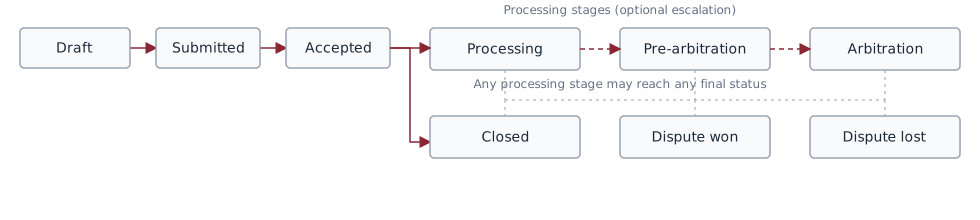
An accepted case that does not enter subsequent processing may become closed. A case in processing, pre-arbitration, or arbitration may become dispute won, dispute lost, or closed. Actual status names and transition paths are determined by the platform.
| Status | Description |
|---|---|
| Draft | The dispute request has been saved but not formally submitted |
| Submitted | The dispute request has been submitted and is awaiting acceptance |
| Accepted | The case has been accepted and has entered subsequent processing |
| Processing | The case is under review or processing and may require additional evidence |
| Pre-arbitration | The case has entered pre-arbitration for further handling of the prior outcome |
| Arbitration | The case has entered arbitration for further determination under applicable rules |
| Dispute won | The dispute is upheld and the related amount is returned according to the final handling outcome |
| Dispute lost | The dispute is not upheld and the original transaction fund outcome remains unchanged |
| Closed | The case has ended because it is ineligible, outside the permitted timeframe, withdrawn, or otherwise closed |
Fund handling outcome
Fund handling is determined by the final dispute outcome. Submitting a dispute does not reverse the original transaction or temporarily return the disputed amount to the card balance during processing. Any related fund movement is processed after the case concludes, based on the final supported amount.
| Case stage or outcome | Fund handling | What to review |
|---|---|---|
| Submitted, accepted, or processing | The original debit remains unchanged and the disputed amount is not temporarily returned to the card balance | Monitor the case status and any requests for additional evidence |
| Dispute won | The final supported dispute amount is returned to the card balance | Review the final status, supported amount, and card balance movement |
| Dispute lost | No dispute refund is issued and the original transaction fund outcome remains unchanged | Review the case outcome and original transaction fund record |
| Closed | No dispute refund is issued and the original transaction fund outcome generally remains unchanged | Review the closure reason and related transaction records |
The dispute amount should reflect only the amount actually in dispute. Any partial refund or other funds already returned for the original transaction should be excluded from the requested amount. The amount actually returned is determined by the final handling outcome.
Confirm the result using the final case status and the relevant transaction records.
Improving dispute success rates
A successful dispute request contains sufficiently detailed and complete information for all parties to clearly understand the reason for the dispute. Key practices for improving the likelihood of a successful outcome include:
- Include a detailed description of the purchase for consumer disputes
- Provide as much independent supporting evidence as possible
- Clearly explain the basis for the dispute
- Exclude any amount already partially refunded from the dispute amount
Query transaction records
Learn how to query, download, and reconcile purchase transaction records and card account ledger records, and how the two record types are linked.
Data security and compliance requirements
Learn about card data protection, transaction risk control, identity checks, AML requirements, and compliance responsibility boundaries in issuing.